


In brief: C3 Labs just entered its public phase this month: we launched the co-design phase with coalition partners and the cross sector community in Bangkok, 9 September - with a full-day technical workshop, followed by an open Community, Ecosystem and Partnership Exchange. Singapore, 10 September - with a systems finance R&D laboratory AT ONE Impact Week 2026 Impact Week, and finally Nairobi, 15 September - also with a full-day technical workshop and Exchange. We will soon share more about what we did and learned overall, yet this post dives deeper into our systems finance work - what we learned in real-time and where we ambition to take this work moving forward. Specifically, this post unpacks our session that ran in Singapore, co-hosted by C3 Labs (UNDP) with the Symbiocene Initiative (Georgetown and MIT), the No.17 Foundation and SecondMuse. Our session included a twenty-five minute provocation panel, then an hour of laboratory, followed by a roundtable. Curious about C3 more? you can see the mini Substack series here too.
A note on this post: written by Courtney Savie Lawrence (C3 Labs Co-lead, UNDP) and Parijat Chakrabarti (C3 Labs Systems Finance Advisor, co-founder of the Symbiocene Initiative, Georgetown and MIT), who co-designed and co-moderated the session. “We” means the two of us rather than the wider C3 partnership. We stated the audio-capture position out loud before anything else, and naming is opt-in, so nothing below is attributed and nothing is quoted directly. The patterns are reported; the people are not.

Our starting point
C3 Labs incubates multi-sector collaborations as a catalytic response to some of the world’s most complex challenges, starting at the nexus of climate-biodiversity-food systems. Think of entrenched challenges like air pollution, extreme heat, and rising oceans, and you can quickly get the picture. While our approach is place based, cross- sector, ‘people first’ (vis a vis a C3 Labs Fellowship model set to kick off in 2027), with pilots in Thailand and Kenya initially, this post focuses on the capital side of making complex sustainability and regenerative development transitions possible. If this is your first time to our working and learning out loud posts, you may want to see What C3 Labs is Testing and Why, and The C3 Country Lab Model, and Its Limits for more background context.
On September 10th, NO.17 Foundation co-hosted our sessions at One Impact Week Singapore. Our intent was to get to the heart of where the field of capital orchestration sits now, and crucially where patterns and gaps remain. As C3 Labs is designed to function as a pipeline incubator for cross-sector and systems-informed portfolios, we know we need to think about finance on day one, in tandem with the “how”.
In short we ask: what gets in the way of collaboration for complex challenges - and how do we underwrite (and finance) the “invisible infrastructure”, the connective tissue required to orchestrate systemic transformation efforts?
We held two key arcs of conversation, each anchored by provocations. The first was set up as What Capital Cannot See: A Systems Finance R&D Laboratory, followed by The Ten-Year Term Sheet: Coalition-Building for Capital Orchestration roundtable. Our first session also featured an ‘Edge Panel’, intentionally curated to allow for a mix of capital archetypes. We were fortunate to have the following leaders from across the spectrum join:
James Ong, Chief Executive Officer, Investment Committee Member, Gingko Asset Management, Tsao Pao Chee (Commercial capital);
Kirsten Dunlop, Chief Executive, Climate KIC (The orchestrator);
Nicole Campbell, Co-CEO & President, Rockefeller Philanthropy Advisors (Philanthropic capital and its governance); and,
Irina Goryunova, Deputy Resident Representative, UNDP Thailand (Development and concessional capital).
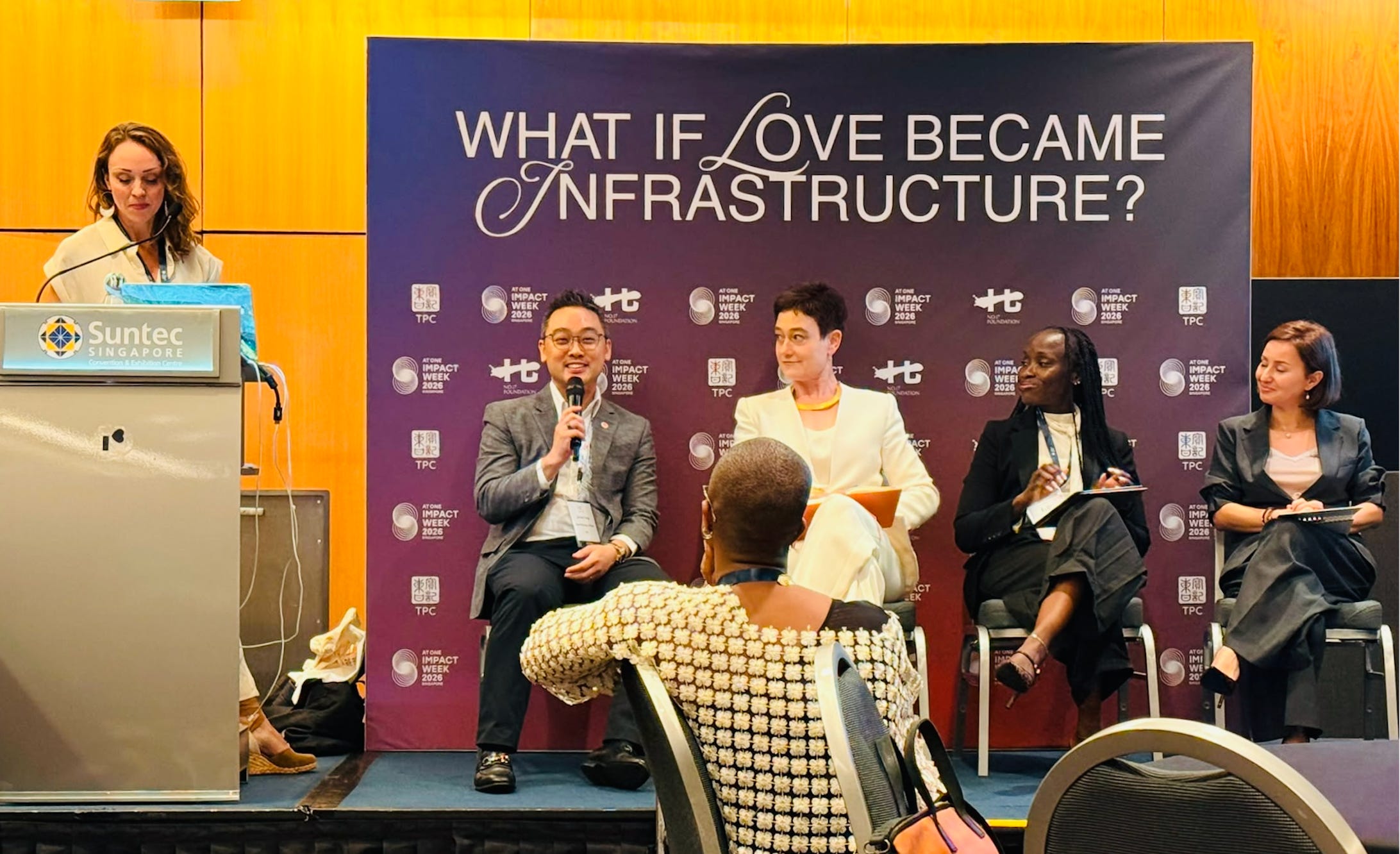
Following the panel, our four speakers left the room, and we held 3 group breakouts, with the audience, to dive deeper, recorded with our iphones, and then with transcriptions plugged into Claude to seek patterns, outliers and anonymized takeaways. Below we map out what happened and share our top insights and next steps.
What we explored and discovered together
We often see capital flowing easily to discrete projects and portfolios. Yet it struggles to fund complex, long-horizon, interconnected systems change — and especially the connective tissue of an ecosystem, the trust and credibility built conversation by conversation. Initiatives at that scale ask for coalitions capable of stewarding coherent action across philanthropy, government, private sector, academia, and civil society.
The key provocation our laboratory took on is: What if multi-sector collaborations could be incubated in a systematic and repeatable way (much like we incubate startups)? And could we design them to support complex sustainability transitions at different scales?
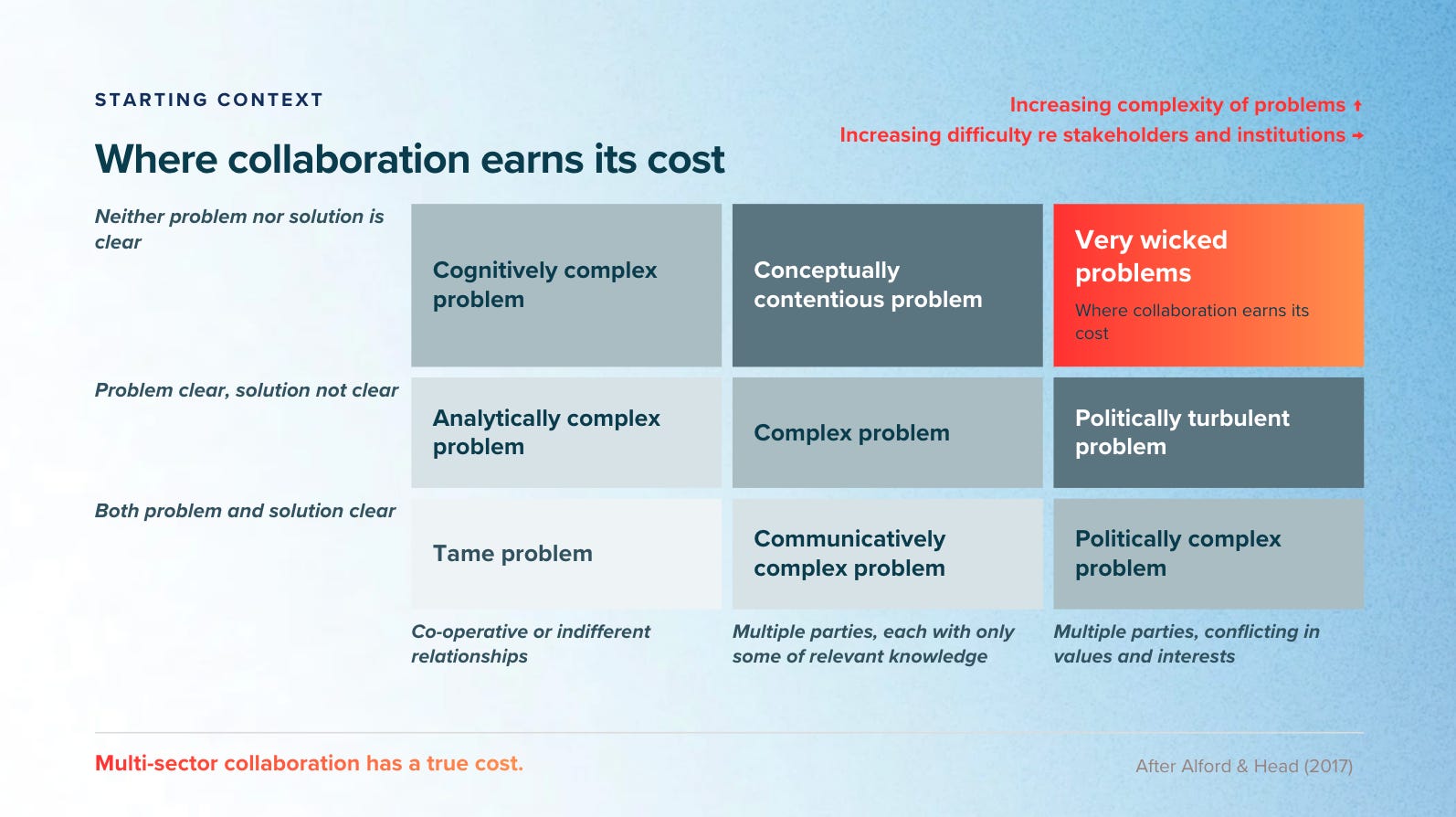
One thing we wanted to establish early, because it related to everything that followed: multi-sector collaboration is not always the right approach, and it has a true cost. Plot problem complexity against the difficulty of the stakeholder and institutional landscape, after Alford and Head (2017), and most of the grid does not need it (image above). Tame problems do not, nor do analytically complex problems with cooperative relationships. Collaboration earns its cost in the upper right, where neither problem nor solution is clear and multiple parties hold conflicting values and only partial knowledge.
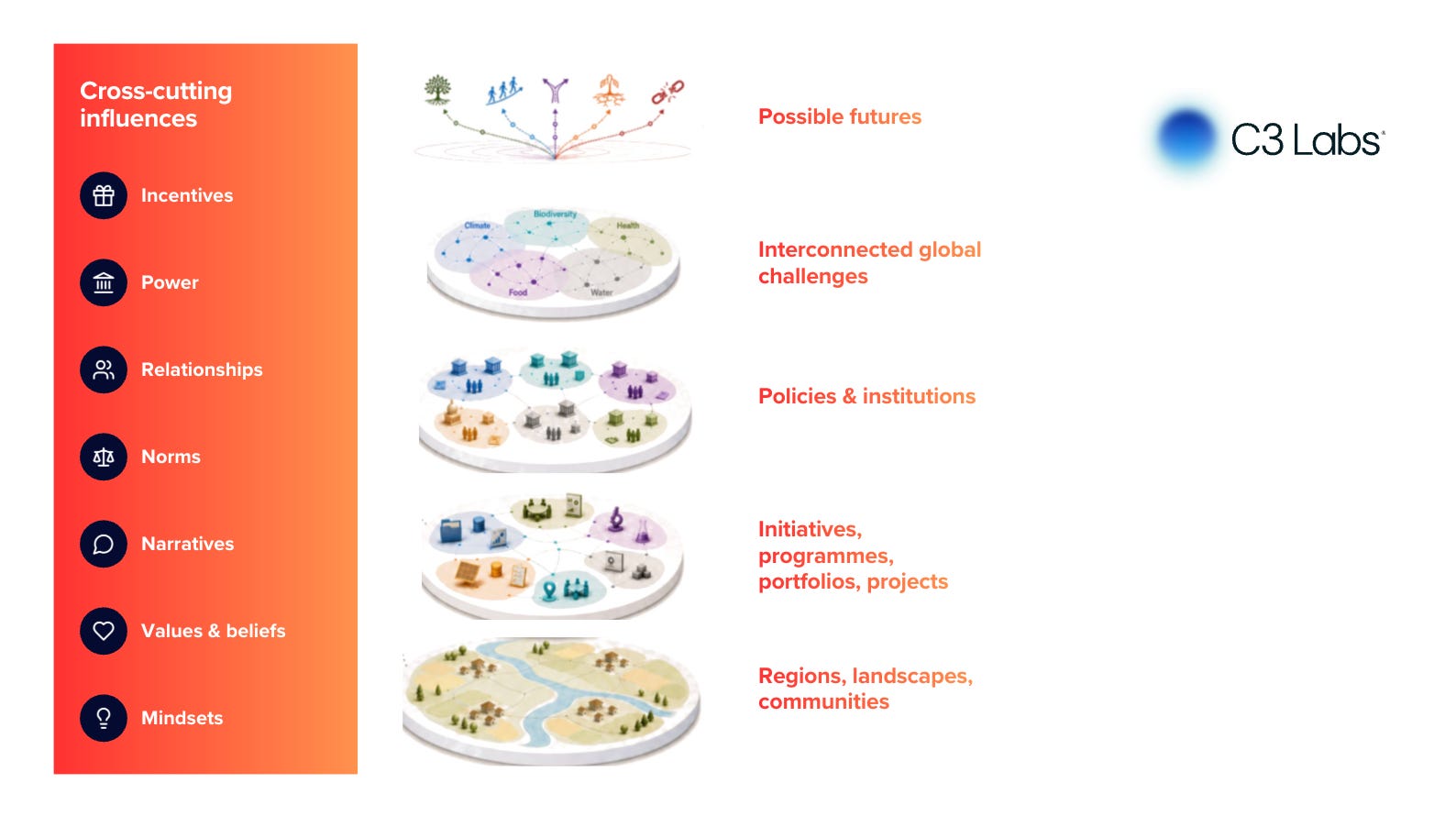
The laboratory
We then moved into smaller groups to focus on crowdsourcing feedback in terms of the following:
Track 1 — Underwriting the invisible. Trust-building, problem structuring and coordination underpin systems change and are rarely fundable line items. What are the under-resourced capabilities needed to hold systems change, and how do we finance them on purpose?
Track 2 — Orchestrating the mix. Complex transitions need the right capital in the right place, right sequence, and right time. However, standard governance frameworks hold philanthropic, public, and commercial capital apart. What are the frictions in coordinating different kinds of capital, and how can we reduce them?
SecondMuse anchored the work with a live case from the discovery phase of their Indonesia portfolio, so the tracks had something real to argue with rather than a hypothetical.
Five things we heard
1. There are various workarounds, and nobody pointed to one singular mechanism
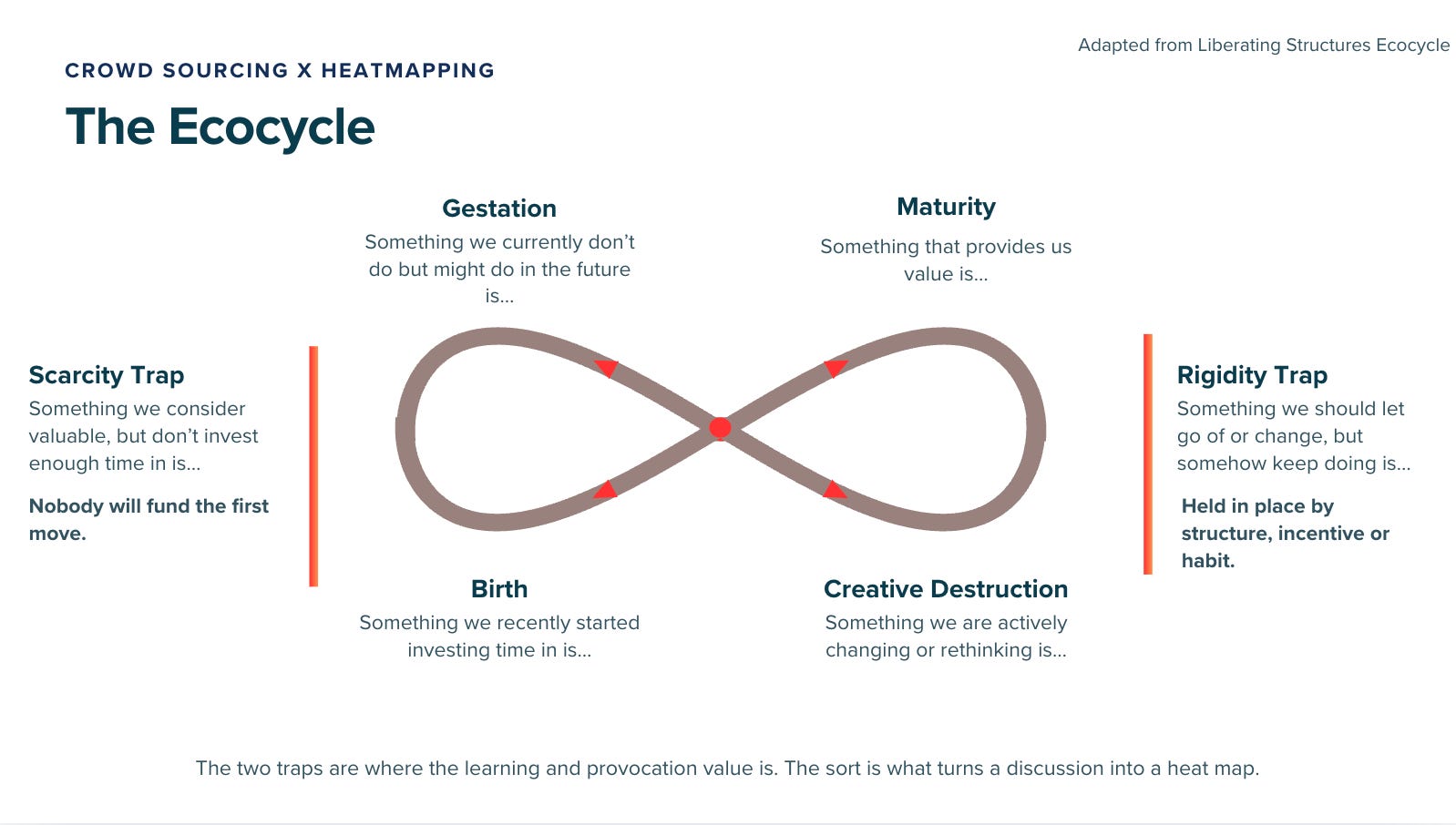
One table called it the “Trojan horse”: study the funder, wrap the work in language the dominant system already understands, get it funded, build the real thing on the side out of the margin. Another described turning the organisation inside out to squeeze money loose, or using money nominally allocated to something else. A third described capital as legally tagged by its own structures, so the only route to flexibility is holding several differently-tagged pools at once and moving between them. Someone observed that these workarounds happen frequently, and it is simply how the work gets done. In Ecocycle terms this is textbook rigidity trap. The sector has a functioning covert practice and no codified mechanism to move beyond these habits and practices, mostly because of the existing not-so-fit for purpose systems.
2. The participants moved our target
We had been asking who pays for the connective tissue, and the answer that came back was more precise. Early systems mapping can and does get funded, often by philanthropy, yet not necessarily easily done by other sectors. What cannot be funded is the conversion. You complete the mapping, you can see the shape of a portfolio forming, and the step from there to something an investor can actually take on is where the money is not. It was described as a large gap and extremely difficult to finance. The unfunded step is conversion, not convening. That single insight is invaluable, and our work in progress concept note is being amended around this.
3. It is sometimes a mandate problem, not a sophistication problem
We asked directly whether the gap is that investors do not yet understand this. The answer was effectively no. Capital flows under mandates, and the spaces that matter here produce various returns or mix public and private goods, so conventional approaches cannot assess them at all. Basically, contemporary instruments are typically not built for this purpose. For example, a few specific illustrations came up in the breakout conversations: venture capital tagged by its own legal structure can only evaluate on exit; one fund can hold a sovereign LP measuring success in job counts alongside another measuring it purely financially; asset owners carry fiduciary duty to pension beneficiaries and cannot abandon traditional measures however personally convinced they are. All of this can quickly become a known frustration for anyone whose theory of change includes impact. Persuasion does not move a mandate. Mandate design, accounting treatment and fiduciary interpretation do.
4. The invisibility is not always accidental
What you measure is what you get resourced for. The systems-change factors, like strengthening government policy and talent, building community leadership and power, including marginalised voices, routinely appear in programme design and yet less frequently in programme goals. They are in the method or process, and not necessarily in the target, so they are not always measured and rarely funded as ends. Metrics, as most of you who are still reading this, often do not talk to each other across government, academia and philanthropy. Regulator-mandated climate scenario modelling was described as a reporting artefact rather than a decision input. And example that concretely came up: even where systems language has been adopted inside responsible investing, in practice it resolves into sectoral value chains. The infrastructure producing the positive externalities that make everything else possible is still not what gets funded. This is the scarcity trap, exactly as the Ecocycle describes it. Not a knowledge problem, as indeed the measurement architecture is doing what it was built to do.
4. Accommodate or confront?
The “Trojan horse” is accommodation: speak the dominant language, get it funded, build quietly. Against it, a position carried in from another session that morning- be brave enough to stretch funders towards discomfort rather than capitulating, because the incumbent system logic is so entrenched. The practical form suggested was gentle interrogation: ask a funder what they believe matters most here, and what makes them assume it is easy to measure. A third position surfaced in the breakout analysis we ran and was between: the old world still holds the controls, the new language is real but esoteric, and the task is to build new practices that meet everyone where they are. Of course this is far from settled, and it remains one of the most interesting points of tension from the afternoon.
The one idea shaped like a vehicle
Amid a great deal of diagnosis, one proposal had the shape of a mechanism, and it came from a participant rather than from us. “Value ripple effects” can be made more tangible without being made exact, for example, preserve a landscape and you produce health for people and for place (and that can be valued). Orient unlikely stakeholders around a shared sense of value in a specific place and they begin to align. The question that follows is a useful one: what asset or vehicle holds those agreements in place, so you are not funding something and hoping trust holds? Something a community holds in shared stewardship alongside funders, possibly where communities are themselves funders, with finance organised in service of it rather than the other way round. A second model came from another table: a multi-party cooperative structure, built on new national regulation, where investors participate but the community holds ownership power.
The challenge aimed at many of us
One of the most provocative things said was aimed at everyone in the room, conveners included. Capital habitually sees nothing where something already exists, and arrives to fill the gap. That move was compared directly to the colonial gaze — seeing empty land that was never empty. Emergent stewardship practice already operating on the ground was described as dwarfing, in scale, the formal capital being organised to address it. Care work came up in the same register: interstitial, feminised, systematically undervalued, invisible precisely until it breaks, while everything else depends on it.
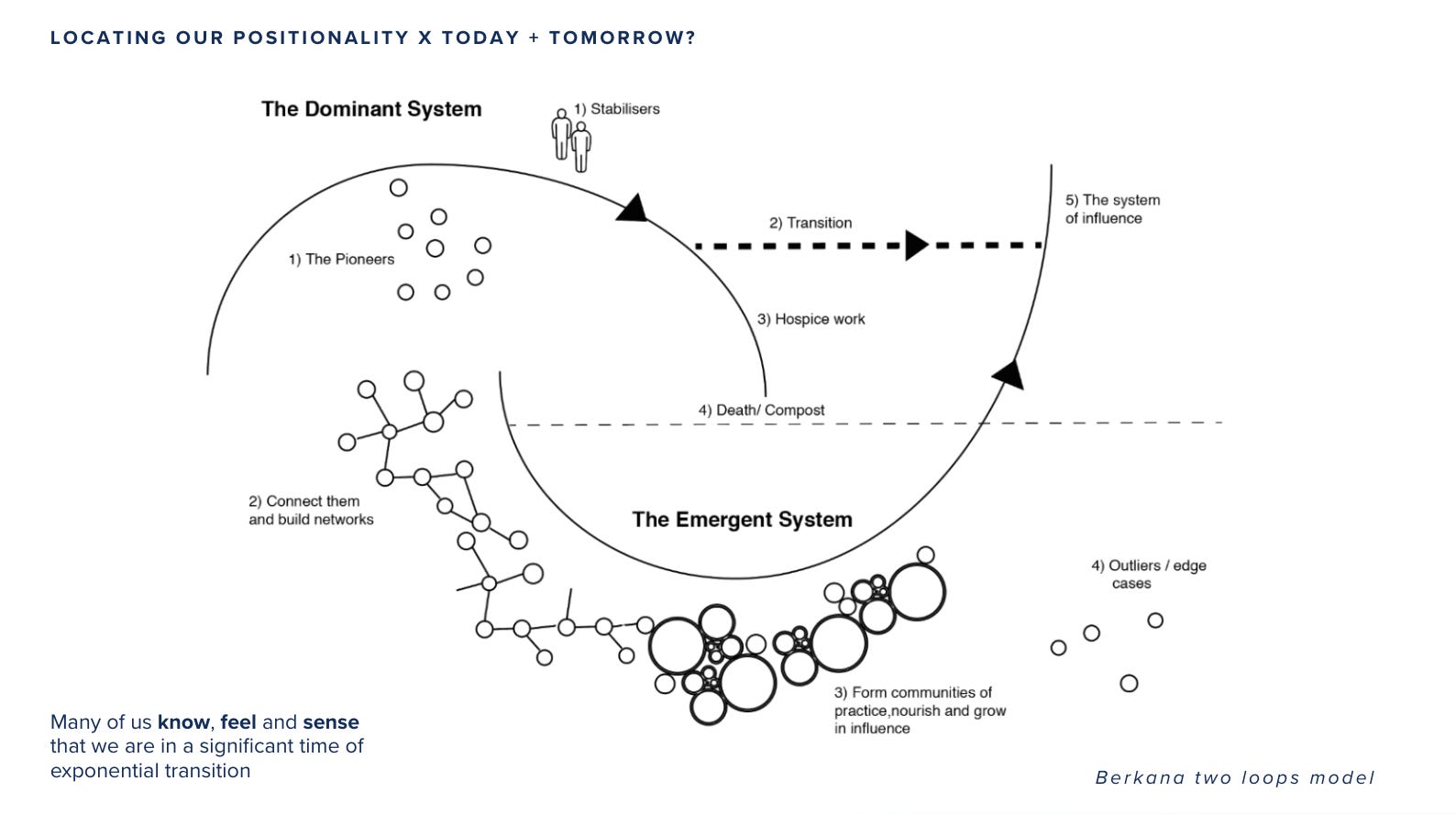
The corrective offered was to stop architecting and start tending. Gardeners, not architects. One investor took it further and argued the goal should be not to have a job as an intermediary at all. We are an intermediary convening a conversation about intermediation. All that to say, it also helps to remind us with what we started the session: the Berkana Two Loops Model - we know we are in a transitory time, and times like these require us all to reflect on our position, positionality in an ever emergent system of ‘systems’:
And the Ten Year Term Sheet - a closed door roundtable
Following the workshop we also held a brief, closed door roundtable: The Ten-Year Term Sheet: Coalition-Building for Capital Orchestration
Coalitions are asked to hold what no single institution can own or exit, yet no one is accountable for the connective tissue that keeps them standing. Whose balance sheet should carry it, and on what terms?
Initiatives aimed at complex systems change rarely fail for lack of ambition — they fail for lack of the connective tissue that makes them fundable, governable, and durable: who does problem discovery and structuring, what governance holds a coalition together, what financing architecture can move grant, concessional, public and commercial capital in the same direction, and what causes these efforts to break down.
While we held this session under Chatham House Rules, we did exchange on many other field building initiatives that all acknowldge change and the temporal reframes required. For example, some of the other fascinating cases that have been highlighted in this regard include:
SecondMuse Capital and UNDP Zambia have built a US$50 million Systems Finance Facility.
Climate KIC has run the Transformation Capital Initiative for years. Rockefeller Philanthropy Advisors runs the Shifting Systems Initiative.
TPC, No.17, Climate KIC and GIIN convene the Impact Partners Coalition for Planetary Well-being.
Octave Capital and Katapult have the Asia Ocean Fund.
UNDP Thailand is working finance mobilisation, INFF and biodiversity finance.
Indeed we are paying close attention to the field, and have been inspired and informed by TransCap Initiative’s Pushing the Boundaries of Integrated Capital Strategies and Financial Backbones, the latest coming out from FEST, TWIST, UNDP’s latest Transformation Portfolio practices, SecondMuse Capital’s work - among many others. There is no question, islands of coherence exist in this space, and we are eager to advance what this means in an applied way, particularly for our work C3 Labs launching in Asia and Africa.
Where this material goes, and how to get involved
The harvest will be going towards a position paper and fund thesis, drafted with elements from what the room expressed and considered against the Country Labs in Thailand and Kenya rather than written in the abstract. This is what we mean by an R&D platform: the research agenda is live, the pilots are running (co-design for the remainder of 2026, and Fellowship/collaboration incubation across 2027), and the findings have somewhere to weave into the work.
Five ways to collaborate with us, in ascending order of commitment:
Introduce someone who should have been in that room. The people asking this question are scattered across institutions that rarely, or don’t always, meet.
Collaborate on the R&D — the position paper and playbook.
Advise on, or join, the Thailand and Kenya systems fund feasibility study.
Co-design or anchor a fund thesis.
Scope and partner on a new opportunity space with us.
You can reach out on c3labs.org or message Courtney Savie Lawrence (UNDP/C3 Labs Co-lead) and Parijat Chakrabarti (MIT/Georgetown University Symbiocene Initiative, C3 Labs Systems Finance Advisor). And if you were in Lab 13 that afternoon, we would like your version of what happened - particularly where it differs from ours.
*Last thing: for those of you reading that will be at New York Climate Week, our wider UNDP team working on systems finance and portfolios, will be hosting this UNGA Side Event: “From Silos to Systems, Projects to Portfolios: How Philanthropy Can Better Support Inclusive Development” on September 23 - a strategic dialogue co-organised by Temasek Trust and with the launch of the latest research report. Parijat will be there sharing more of our latest C3 Labs work too.
C3 Labs — Collaboration for Complex Challenges — is a coalition led by UNDP in partnership with FAO, UNEP and Wageningen University & Research for the global, Kenya and Thailand lab implementation, seed-funded through the GEF-8 Innovation Window, with OPDC in Thailand and KIPPRA and the Ministry of Environment, Climate Change and Forestry in Kenya. The systems finance research is underway via a collaborative research partnership with MIT and Georgetown University. More at c3labs.org.