C3 Labs is one of seven projects selected from 128 applications to the GEF's first Innovation Window. Two Country Labs, dozens of Fellows, and a hypothesis to test.
In brief:C3 Labs — Collaboration for Complex Challenges — officially launches this month, with pilot Country Labs in Thailand and Kenya. It is led by UNDP with FAO, UNEP and Wageningen University & Research as core global partners, and seed funded through the Global Environment Facility (GEF)‘s first Innovation Window. Three public workshop sessions follow: in Bangkok on 9 September, Singapore on 10 September, and in Nairobi on 15 September (each requiring advance registration - details at c3labs.org). This post sets out what the project is testing; Part 2 and 3 covers the practical details.
A note about our approach: we aim to learn, reflect and work out loud, share the reasoning while it is still provisional, and stay candid about the parts that may not hold. This set of writing is written by the C3 Labs global team co-leads, Charles O'Malley (UNDP) and Courtney Savie Lawrence (UNDP), drawing on project documents developed with our partners. "We" throughout this series refers to the co-leads rather than to the wider partnership; where a partner institution holds a position, we name it. Three posts this week. Today, the problem C3 was designed to address. Tomorrow, the Lab model itself. Thursday, where the conversation continues in person.
The problem, as stated
Biodiversity loss, climate change and unsustainable food systems are interconnected. That is no longer seriously contested. What remains harder to explain is how shared challenges can translate into effective collaborative action. C3 Labs identifies key barriers including: institutional silos, fragmented mandates, short-term project cycles, rigid planning and reporting frameworks, inter-institutional competition, and limited capacity for systems thinking and collaboration. None of those constraints is a knowledge problem. None is resolved by another dashboard, evidence platform or strategy document. Each is, in some form, a question about how institutions and the people inside them are able to work with one another more effectively. That is a key gap C3 has been designed to test.
The Innovation Window, and what it is for
The GEF was established in 1991 in the run-up to the Rio Earth Summit, and across successive programming cycles has placed increasing emphasis on integrated approaches and systems transformation. Under GEF-8 it created an Innovation Window to test and pilot novel approaches — technological, financial, business-model, policy and institutional — generating evidence and tools capable of improving future GEF programming.
Thanks for reading C3 Labs - Collaboration for Complex Challenges Substack! Subscribe for free to receive new posts and support my work.
C3 was one of seven projects selected from 128 proposals. It was chosen to test a novel response to a persistent institutional problem: whether a Fellowship and Collaboration Lab can strengthen systemic, collaborative and adaptive approaches to complex environmental challenges, and generate evidence useful beyond the project itself. (UNDP’s announcement at the time is here). This is not funding to deliver a known solution at scale. It is funding to establish whether something works. Which makes the accurate description of this moment a modest one: we hold a hypothesis, two countries have agreed to test them with us, and the outcome is genuinely open.
The hypothesis
Our hypothesis is that more effective action on complex environmental challenges requires deliberate investment in trust, relationships, collaborative capacity, systems leadership, adaptive learning and cross-institutional alignment.
The approach is easy to endorse and difficult to fund. Trust does not appear as a line item. Relationships are not a deliverable. Collaborative capacity has no obvious indicator. So they tend to get assumed rather than resourced. Whether deliberate investment in them makes a measurable difference is the question C3 exists to answer.
The Labs are therefore structured innovation pilots rather than delivery vehicles. Evidence may be positive, negative, mixed or inconclusive, and the project commits explicitly to documenting what appears to be working, what is not, what remains uncertain, and what conditions would need to change for stronger outcomes to emerge. We want to state that commitment at the outset, because the beginning of a project is exactly where quiet over-claiming tends to start.
Seeing connections across layers
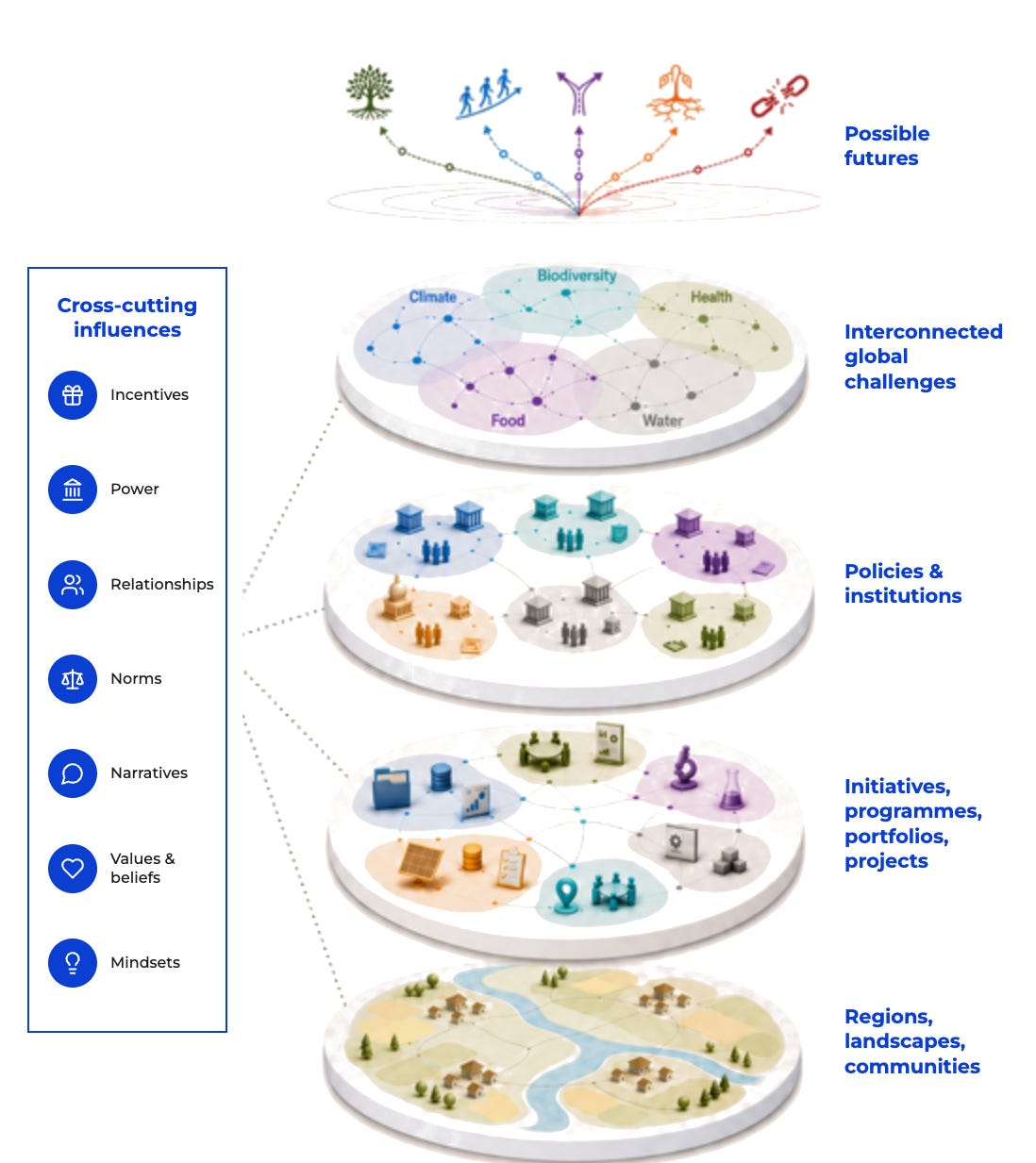
The Connected Layers of Change - a conceptual model under development - explores the relationships between interconnected global challenges and action at different levels including policies and institutions, programmes, initiatives and projects, and regional and local action, making visible the cross-cutting influences that shape those responses and influence the direction of travel and possible futures.
image credit: Charles O’Malley, UNDP and C3 Labs, 2026. Inspired by: ‘Challenges + Impact Map’ (Griffith University, Centre for Systems Innovation, 2020), the Water of Systems Change (John Kania, Mark Kramer, and Peter Senge, FSG, 2018), the Iceberg Model (Peter Senge) and 12 Leverage Points to Intervene in a Systems (Donella Meadows, 1999).
Challenges such as climate change, biodiversity loss, food insecurity, water stress and health are interconnected. The difficulty is not only understanding those connections, but seeing how responses in one part of the system can reinforce, constrain or undermine action elsewhere. Different ministries and institutions may pursue competing mandates or incentives; policies can pull in opposite directions; portfolios and programmes can duplicate effort, leave gaps or compete for resources; and local realities can expose tensions that are obscured at higher levels.
The Connected Layers of Change model helps surface synergies, tensions, trade-offs, bottlenecks, unintended consequences and possible leverage points that are easy to miss when issues are considered separately. It also draws attention to critical cross-cutting influences - mindsets, values, narratives, norms, relationships, power and incentives - which shape what institutions prioritise, how people collaborate, whose perspectives count and which futures become more or less possible.
No single institution holds the whole picture, and no single institution has the authority or capability to act across it.
The partnership
As interconnected challenges span institutions, levels and competing perspectives, no single actor can see or act on the whole. The composition of the C3 partnership is a central part of the C3’s methodology and potential for impact:
Globally, C3 is led by UNDP with FAO, UNEP and Wageningen University & Research as core partners, seed-funded through the GEF Innovation Window. FAO contributes food and agriculture policy and institutional depth; UNEP contributes climate and biodiversity alignment and co-leads the Global Learning Lab; Wageningen contributes methodology, learning and research.
In Thailand, the core national partner is the Office of the Public Sector Development Commission (OPDC), whose Government Administration Development Strategy 2024–2027 emphasises cross-agency working, participation, innovation and responsive government — a useful institutional bridge into this kind of inquiry. Delivered with UNDP Thailand.
Each country brings substantial policy ambition, institutional capability, technical expertise and functioning coordination mechanisms. That is the analytically interesting condition, and it is where tomorrow's post begins.
Next
Part 2, Wednesday: what a Country Lab consists of — thirty Fellows, twelve months, two retreats, two workshops, and no formal authority — including a considered account of what C3 cannot do.
Part 3, Thursday: Bangkok, Singapore and Nairobi.
C3 Labs — Collaboration for Complex Challenges — is led by UNDP in partnership with FAO, UNEP and Wageningen University & Research, seed-funded through the GEF-8 Innovation Window, with OPDC in Thailand and KIPPRA and the Ministry of Environment, Climate Change and Forestry in Kenya. More at c3labs.org.
Thanks for reading C3 Labs - Collaboration for Complex Challenges Substack! Subscribe for free to receive new posts and support my work.
Thank you for sharing so candidly Charles. I’m looking forward to reading about the process over time. The terminology used sounds like an application of Heifetz’s ‘adaptive leadership’ and Meadow’s leverage points - within a worldview of complex adaptive systems. Is that so?



Thank you for sharing so candidly Charles. I’m looking forward to reading about the process over time. The terminology used sounds like an application of Heifetz’s ‘adaptive leadership’ and Meadow’s leverage points - within a worldview of complex adaptive systems. Is that so?