


In brief: C3 Labs — Collaboration for Complex Challenges — officially launches this month, with pilot Country Labs in Thailand and Kenya. It is led by UNDP with FAO, UNEP and Wageningen University & Research as core global partners, and seed funded through the Global Environment Facility (GEF)‘s first Innovation Window. Three public workshop sessions follow: in Bangkok on 9 September, Singapore on 10 September, and in Nairobi on 15 September (each requiring advance registration - details at c3labs.org). Part 1 set out what the project is testing, this post covers the practical details, and part 3 covers Bangkok, Singapore and Nairobi.
A note about our approach: we aim to learn, reflect and work out loud, share the reasoning while it is still provisional, and stay candid about the parts that may not hold. This set of writing is offered by the C3 Labs global team co-leads, Charles O’Malley (UNDP) and Courtney Savie Lawrence (UNDP), drawing on project documents developed with our partners. “We” throughout this series refers to the co-leads rather than to the wider partnership; where a partner institution holds a position, we name it.
Beginning with what already exists
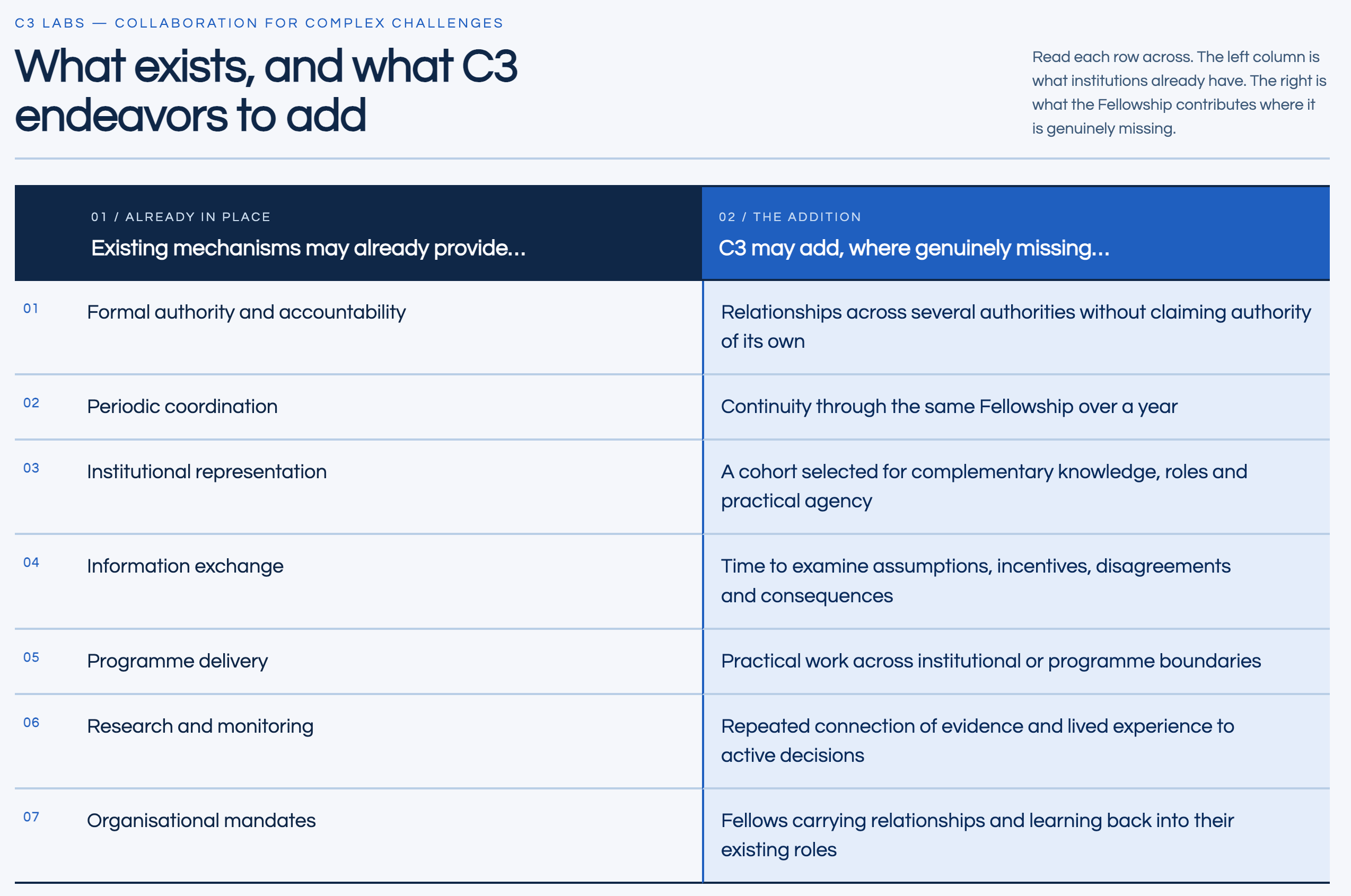
Yesterday’s post closed on a claim we want to continue expanding: that neither Kenya nor Thailand comes to this with a capability deficit. Both possess substantial policy architecture, technical expertise, research institutions, coordination mechanisms and people who understand their systems well. In fact, and of course, we needed to ask ourselves: why use a C3 Fellowship and Collaboration Lab rather than an existing government mechanism, programme process or partnership?
Kenya already has sector coordination mechanisms, county planning and budgeting, intergovernmental structures, programme steering arrangements, research–policy relationships and development-partner coordination. Thailand has national planning and reform bodies, sector ministries, provincial administration, basin institutions, and a Policy Lab that has conducted policy experimentation and cross-agency innovation at scale for years.
These mechanisms hold functions and authority that C3 does not. In line with the spirit of our manifesto we are also clear: where an existing mechanism already brings the necessary people, authority and knowledge together effectively, C3 should work through it, strengthen it where useful, or simply stay out of the way.
Wait, another lab? what do you mean?
We also need to raise the obvious and uncomfortable question. If the capability already exists, what is a Lab for? And what do you mean by lab in the first place?LIn this context we are starting with ‘C3 Country Labs’, where a 12-month action-learning process running through 2027, convening approximately 30 Fellows from government, civil society, the private sector, academia, development partners and other institutions. The experience will entail two residential retreats, two non-residential workshops, and sustained work between them. Fellows remain embedded in their own institutions throughout. Gender balance and gender-responsive design are core selection principles. It is not a training course, a consultation, or a series of events. Importantly, we ambition to help accelerate the cross-sector relational infrastructure, the connective tissue of relationships that sometimes get stuck in silos and entrenched fragmentation. It is not everyday that you can convene a genuinely multi-stakeholder group to tackle complex problems - not just complicated, but the ones that by default will never fit in a neat systems thinking map.
What C3 may add
We posit that the potential ‘C3 contribution’ is a sustained space for people who hold different parts of an important challenge to understand it together, build relationships they would not normally have, and work on practical possibilities while remaining embedded in the institutions and constituencies that can act. No single part of this is novel. The proposition lies in the combination.
The unit of additionality is not “more collaboration”, but the transformational opportunity that deepening relationships and alignment among ‘portfolios of portfolios’ and ecosystemic networks surfaces over time - something special that never could have existed otherwise.
The twelve-month shape
Three phases give the fellowship year its direction and overall arc: of exploring complex challenges in the nexus space, cross pollinating portfolios and pipelines, and generating new portfolios of actions, interventions, initiatives, and projects
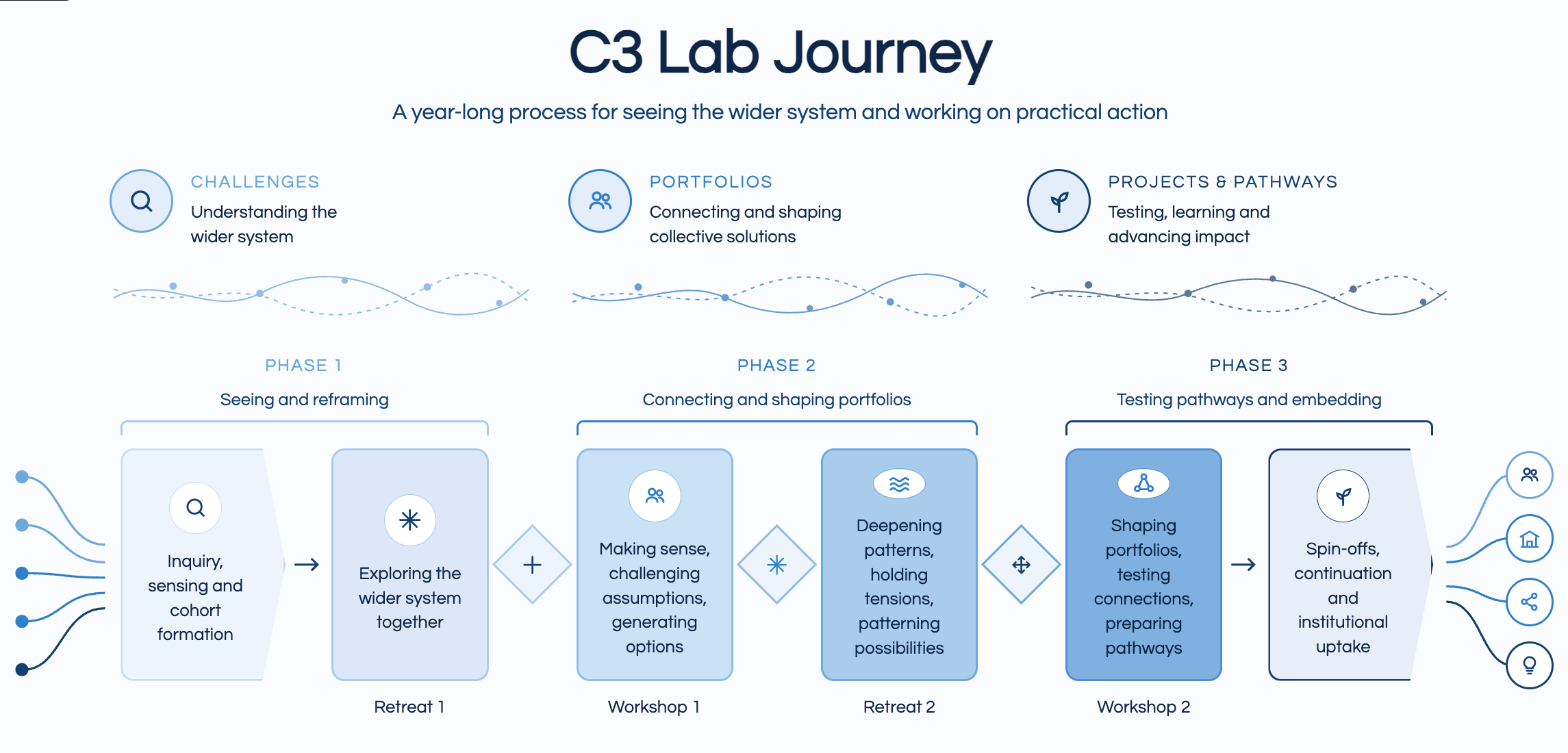
Seeing and reframing. Fellows begin by bringing together different histories, evidence, institutional perspectives and lived realities. The design principle here sits paradoxically with conventional project logic: a good first phase should render the initial diagnosis more accurate, and probably less certain.
Connecting and shaping systems-informed possibilities. Attention moves toward the programmes, investments, relationships and decisions through which something might change. Fellows use practical inquiry and systems-led approaches between gatherings to examine where existing work can be created, connected, adapted or challenged.
Testing ‘portfolio of portfolio’ pathways and integrating learning back. What can be tested, and what should continue through existing institutions? We anticipate that some ideas will advance, others are altered, perhapstransferred to an existing mechanism, or stopped and decelarated. The Lab does not need to own what follows, but the intent is to generate a pipeline that can and should attract systemic finance.
The work between gatherings
The retreats and workshops are anchors rather than the whole. This is what most distinguishes the model from a well-run convening series, and it is the hardest element to convey on a slide.
Between gatherings, Fellows might follow a live decision through different institutions; engage colleagues, communities and decision-makers beyond the cohort; test assumptions against evidence, practice and lived experience; introduce new perspectives into an active policy, programme or investment discussion; explore a bounded change in a rule, relationship or way of working; and bring results, resistance and unexpected consequences back into the Fellowship.
Importantly, this is not designed to be four interesting meetings spread across a year, but a genuine container of key relationships that are held with trust and care, and fascinated by how to do more, together, in these urgent times. Our first nexus issue is focused on climate-biodiversity-food - and there is no question we can, and should, be racing to work more strategically, together.
Who a Fellow is, and is not
We are starting with the design of curating and convening a group of approximately thirty fellows per country. The intent of the Fellowship, however, is not to reproduce a stakeholder list. The composition logic is actually set up the other way: work thoughtfully amongst a wide set of actors to identify the work first, then assemble the coalition capable of doing it. This is part of what we are kicking off next week in our launches across Bangkok and Nairobi where base line analysis, which have already been developed, can further be refined, evolve or even cut to pieces.
So much of this is about context and how the challenge holders see the nexus space. Depending on the eventual inquiry, that may mean people with formal authority or access to it; practical responsibility for implementation; knowledge of particular places or communities; research and technical expertise; financial or market influence; the ability to work across institutional boundaries; and direct experience of carrying the risks and consequences of decisions.

The idea is for fellows to remain embedded in their institutions and constituencies, since the Lab is not intended to become a separate project team. Curation and selection also strives for significant gender balance and meaningful representation of underrepresented and affected perspectives.
Two distinctions took some time to for us to articulate properly. First, seniority and Fellowship suitability are not the same thing. Some of the people most consequential to a Lab may not be the right participants in every gathering; senior sponsors can protect time, create permission and open access to decisions without joining a twelve-month process. Second, and more demanding: for people whose livelihoods, land or rights are directly affected, the standard is meaningful influence rather than symbolic representation. Attendance is not equivalent to the ability to change the inquiry, and no individual should be treated as speaking for an entire constituency.
At the same time, C3 works at the unit of the individual, when taken together in ‘aggregate collaboration’, fellows may influence decisions, yet, most likely not approve a budget, regulate a market, allocate water, determine land rights or require an organisation to change its programme. So it’s important to remember positioning. C3 will most likely be most relevant where several institutions or constituencies hold necessary parts of a consequential issue, where existing arrangements do not adequately connect those parts, and a sustained Fellowship has a realistic opportunity to improve how people understand, decide or act together.
Lenses for approaching the inquiry and challenge frames
The purpose of the upcoming September technical workshops ahead is to have these concepts and hypotheses tested, challenged, combined, reframed or possibly even replaced! Our internal research and briefing notes, co-generated with our coalition of partners will be shared live. In broad brush strokes:
In Kenya, three lenses: national–county and county–county co-governance and implementation; production, markets and ecological resilience; and restoration, livelihoods and living landscapes. These are not three proposed projects. They are three ways of looking for the right challenge frame.
In Thailand, a cross-cutting implementation lens: From Plans to Place, applied alongside three inquiry areas: water allocation, food production and ecosystem needs; haze, burning and agricultural livelihoods; and coastal development, biodiversity, fisheries and livelihoods.
Next
Part 3, Thursday: Bangkok on 9 September, Singapore on 10 September, Nairobi on 15 September. What each session is for, who it is intended to reach, and how to register.
C3 Labs is led by UNDP with FAO, UNEP and Wageningen University & Research, seed-funded through the GEF Innovation Window, with OPDC in Thailand and KIPPRA and the Ministry of Environment, Climate Change and Forestry in Kenya. More at c3labs.org.