


In brief: C3 Labs enters its public phase this month: Bangkok, 9 September - a full-day technical workshop, followed by an open Community, Ecosystem and Partnership Exchange. Singapore, 10 September - a systems finance R&D laboratory at Impact Week, followed by an invitation-only roundtable. Nairobi, 15 September - full-day technical workshop and Exchange. Every session requires advance registration, and capacity is limited. Details at c3labs.org.
A note about our approach: we aim to learn, reflect and work out loud, share the reasoning while it is still provisional, and stay candid about the parts that may not hold. This set of writing is offered by the C3 Labs global team co-leads, Charles O’Malley (UNDP) and Courtney Savie Lawrence (UNDP), drawing on project documents and discussions developed with our partners. “We” throughout this series refers to the co-leads rather than to the wider partnership; where a partner institution holds a position, we name it. As mentioned in previous posts, in case this is your first time here, C3 Labs stands for “Collaboration for Complex Challenges” and we are launching with pilot Country Labs in Thailand and Kenya. It is led by UNDP with FAO, UNEP and Wageningen University & Research as core global partners, and seed funded through the Global Environment Facility (GEF)‘s first Innovation Window.
Go time
We have spent months writing, arguing, redrafting and quietly worrying about whether any of this holds up. Next week we find out, because we finally get to put it in front of people who know these systems far better than we do.
Part 1 here and 2 here of this Substack ‘mini-series’ set out what C3, as a coalition, is testing and what a Country Lab actually is. This post is about what we will be doing, and what we are hoping for.
One thing to say up front. Bangkok and Nairobi are not ceremonial launches with a workshop bolted on. We are bringing baseline analysis, provisional challenge frames and a Fellowship model into the open specifically so that the people in the room can take them apart. If we leave with the same slides we arrived with, something has gone wrong.
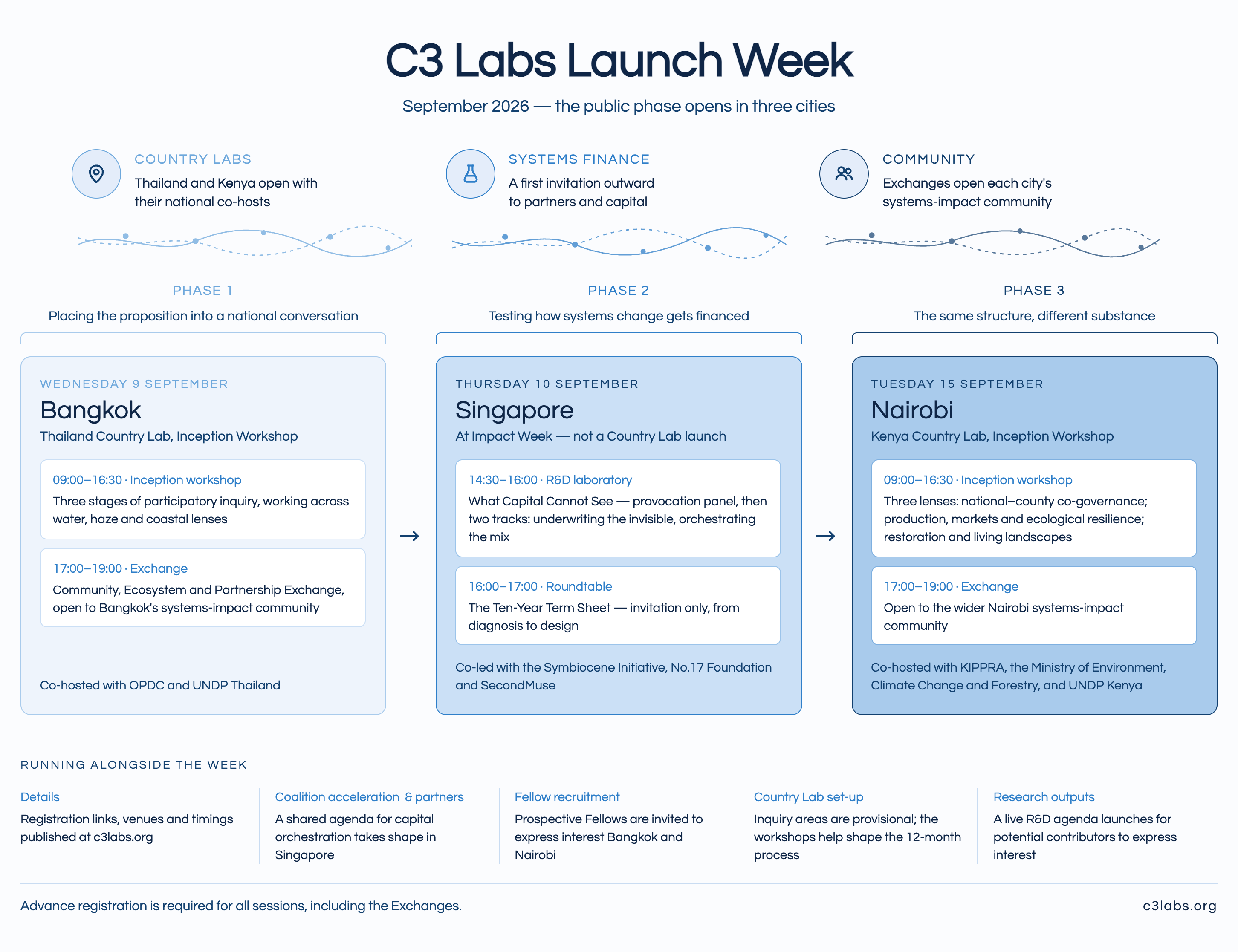
Bangkok · Wednesday 9 September
Thailand Country Lab, Inception Workshop
09:00–16:30, with the Office of the Public Sector Development Commission (OPDC) and UNDP Thailand.
We open with the GEF context, how it aligns with OPDC’s strategic priorities, and a short introduction to the Fellowship and the twelve-month process. Then we hand the day over.
Three stages of participatory inquiry: what Thailand is reaching for and where progress has stalled; a closer look at the challenges and the openings for change; and finally, using all of that to shape the Thailand Lab itself. We will be working across our cross-cutting implementation lens, From Plans to Place, and three provisional inquiry areas — water allocation and ecosystem needs; haze, burning and agricultural livelihoods; and coastal development, biodiversity, fisheries and livelihoods.
We are hoping the room includes national ministries and agencies, provincial and local authorities, producers and the communities most affected, civil society, private sector, academia and research institutes, development partners, and people who might make good Fellows.
17:00–19:00 — Community, Ecosystem and Partnership Exchange.
The most open part of the day, for anyone working on systems impact in the climate–biodiversity–food space in Bangkok. Fewer slides, more conversation and with experience design baked in. This will be held with our local ecosystem partner - Luma invite with details will be shared at C3labs.org
Singapore · Thursday 10 September
Singapore is doing something different, and we want to be clear about that: it is not a Country Lab launch.
It runs in the same week the first two Country Labs go live, which makes it our first invitation outward — to partners interested in co-designing, orchestrating or financing this kind of work.
14:30–16:00 · What Capital Cannot See: A Systems Finance R&D Laboratory
Open to registered Impact Week participants, in Lab 13.
The problem we are circling: capital moves readily toward discrete projects and portfolios, and struggles with the connective tissue — the trust and credibility built conversation by conversation, which turns out to be the thing that determines whether a transition holds together.
Our question for the room: what if multi-sector collaborations could be incubated the way startups are?
Thirty minutes of provocation, then sixty minutes of actual laboratory work across two tracks. Underwriting the invisible asks how coordination and trust-building might be surfaced and financed on purpose. Orchestrating the mix asks why grant, concessional, public and commercial capital are still held apart, and what dissolves that. We are riffing off of the Liberating Structures Ecocycle frame to help structure the conversation, and participants who want to can get named attribution in the research output that follows.
Joining us: Kirsten Dunlop (Climate KIC), Nicole Campbell (Rockefeller Philanthropy Advisors), James Ong (Gingko Asset Management and TPC), Irina Goryunova (UNDP Thailand), Riza Aryani (SecondMuse), Parijat Chakrabarti (Georgetown) and Courtney Savie Lawrence as moderator and facilitator. A deliberately mixed set of vantage points on the same question. This session is hosted by C3 Labs and Co-led with the Symbiocene Initiative, incubated at Georgetown’s Tech & Society Initiative and the MIT Sloan Sustainability Initiative, alongside No.17 Foundation and SecondMuse.
16:00–17:00 · The Ten-Year Term Sheet: Coalition-Building for Capital Orchestration
Invitation only, with registration subject to approval — you can request to join here. Presented by TPC (Tsao Pao Chee), hosted with No.17 Foundation and the Symbiocene Initiative.
This picks up directly where the laboratory leaves off and moves from diagnosis to design. The provocation we are putting on the table: coalitions are asked to hold what no single institution can own or exit, yet nobody is accountable for the connective tissue keeping them upright. Whose balance sheet should carry it, and on what terms?
We will work on the term sheet question itself — what a vehicle built for a ten-year, multi-actor transition actually looks like.
Nairobi · Tuesday 15 September
Kenya Country Lab, Inception Workshop,
09:00–16:30, with the Kenya Institute for Public Policy Research and Analysis (KIPPRA), the Ministry of Environment, Climate Change and Forestry and UNDP Kenya.
Same shape as Bangkok, genuinely different substance. We open with the GEF context and Kenya’s national partnership and policy landscape, then move through the same three stages of inquiry — this time across three provisional lenses: national–county and county–county co-governance; production, markets and ecological resilience; and restoration, livelihoods and living landscapes.
Devolution gives this its particular character, and it is part of what drew us here. Counties hold substantial planning, budgeting and implementation responsibility. National institutions hold policy, regulatory, financing and programme roles. And catchments, rangelands, markets and climate risks pay no attention whatsoever to that boundary.
We are hoping for national ministries and agencies, county governments and intergovernmental institutions, producer, community and rights-holder organisations, civil society, private sector, academia, development partners, and prospective Fellows.
17:00–19:00 — Community, Ecosystem and Partnership Exchange,
Similar to Bangkok, this is also open to the wider Nairobi systems-impact community. This will be held with our local ecosystem partner - Luma invite with details will be shared at C3labs.org
What we are actually hoping for
Not endorsement. We would like people to leave with a clearer sense of C3, a wider view of the challenge, a few encounters with people they do not normally work alongside, and questions worth continuing.
What we want to leave with is more pointed: corrections, challenges and rival explanations. The best possible outcome is that someone tells us we have framed the whole thing wrong, and is right.
Taking part
These are working sessions rather than open events, so registration is required for everything, including the Exchanges, and capacity is limited.
Registration links, venues and timings are going up at c3labs.org.
And if someone comes to mind who holds a piece of one of these challenges that we have almost certainly missed, please send this to them. That is the person we most want in the room.
C3 Labs — Collaboration for Complex Challenges — is led by UNDP in partnership with FAO, UNEP and Wageningen University & Research, seed-funded through the GEF-8 Innovation Window, with OPDC in Thailand and KIPPRA and the Ministry of Environment, Climate Change and Forestry in Kenya. More at c3labs.org.